Living in Stone Oak | San Antonio, Texas
Stone Oak is one of San Antonio’s most established master-planned areas, known for top-rated schools, gated communities, and everyday convenience that’s hard to beat. For relocating families who want to live in a neighborhood that’s already established, Stone Oak tends to rise to the top of the list fast.
→ New to the area? Start with the San Antonio Relocation Guide
Stone Oak at a Glance
| Location | North San Antonio, within city limits, bordered by Loop 1604, US-281, and Bulverde Road |
| County | Bexar County (City of San Antonio) |
| School Districts | North East ISD (NEISD) for most of Stone Oak; some areas near the northern edge zoned to Comal ISD |
| Typical Home Price Range | $375K–$650K for most neighborhoods; $700K–$1.2M+ in Sonterra, The Ridge, and luxury sections |
| Home Styles | Late 1990s–2010s construction, traditional two-story layouts, gated communities, golf-course homes; limited new construction |
| Lot Sizes | Typically smaller than Hill Country suburbs, standard suburban lots; some larger lots in luxury sections |
| Commute to Downtown SA | 25–35 min via US-281 S |
| Commute to Medical Center | 20–25 min, one of the best locations in the metro for Medical Center commuters |
| Commute to JBSA-Fort Sam | 30–40 min |
| Commute to JBSA-Lackland | 35–45 min |
| Commute to UTSA / La Cantera | 20–30 min |
| Vibe | Polished, structured, convenience-driven, organized suburban living with everything close by |
| New Construction | Very limited within Stone Oak proper. Primarily a resale market; new construction buyers look to adjacent areas like Bulverde or Boerne |
| Public Transit | None, fully car dependent |
| Nearest Airport | San Antonio International, ~15 min. One of the closest suburban areas to the airport |
What It’s Actually Like to Live in Stone Oak
Stone Oak is the suburb people describe when they say they want something “established.” Not trendy, not up-and-coming, not still being figured out. It’s a well-built, well-located part of San Antonio that has been delivering consistently for 25 years. For families relocating from out of state who want to land somewhere reliable without doing a lot of research into whether it’s going to work out, that’s valuable.
Daily life here is efficient in a way that some suburbs aren’t. The Medical Center is 20 minutes. The airport is 15 minutes. You can get groceries, a dentist, youth soccer practice, and dinner without touching a highway. The 1604/281 corridor has enough retail and restaurant density that most everyday needs are handled within a few miles of home. It’s not exciting in the way New Braunfels is exciting, but it doesn’t pretend to be.
The neighborhoods themselves are predictable. They’re maintained HOAs, mature landscaping on streets that were built before the recent sprawl wave, and a mix of community types from gated golf-course enclaves to traditional subdivisions with neighborhood pools. There’s a reason the resale market in Stone Oak holds up well: people who buy here tend to stay, and the ones who leave sell to buyers with similar priorities.
Most residents choose Stone Oak because they want predictability: strong schools, defined communities, and homes that hold value over time. It’s not a walkable urban area or a rural escape. It’s more of a polished suburban environment designed for everyday living.
For many relocating buyers, Stone Oak offers a sense of familiarity right away, even if San Antonio is completely new to them.
What to Know Before You Commit to Stone Oak
New construction is essentially nonexistent within Stone Oak. If you want a brand new home, you’re looking at adjacent areas north of 1604: Bulverde, Fair Oaks Ranch, or at Boerne for the Hill Country version. That’s not always a dealbreaker, but families set on new construction need to know upfront that Stone Oak is a resale market.
Lot sizes are smaller than what you’d find in Helotes, Boerne, or the Hill Country suburbs. Stone Oak was built at suburban density. You’ll get nice homes, reasonable yards, but you’re not getting half an acre of trees. If outdoor space and privacy are high on your list, you’ll likely want to look northwest.
The 1604/281 interchange and the corridor heading south on 281 can be frustrating during morning and evening rush hours. Most commutes from Stone Oak are shorter in miles than from outlying suburbs, but the surface street congestion around the main shopping corridors can be a pain – especially on weekends when the retail along 1604 draws traffic from a wide area.
HOA rules are consistent and enforced, which most residents appreciate and some find constraining. If you’re the kind of buyer who wants flexibility to customize your exterior, run a home business with visible signage, or park a trailer in the driveway, Stone Oak’s HOA structure will feel restrictive.
Who Stone Oak Is Right For (And Who It Isn’t)
Stone Oak tends to be a great fit if:
- You’re commuting to the Medical Center, USAA, or other major north SA employers — the location is hard to beat for that
- Schools are a top priority and you want NEISD’s established track record — Reagan and Johnson high schools have long histories of strong performance
- You want a neighborhood that’s already built out and functioning — no waiting for amenities or retail to catch up
- Gated communities or controlled-access neighborhoods matter to your family
- Your budget is $375K–$700K and you want proven resale value in an established area
- Airport proximity matters — 15 minutes to SAT is a real advantage for frequent travelers
Stone Oak might not be the right fit if:
- New construction is important — this is almost entirely a resale market
- You want larger lots, mature trees on big parcels, or any sense of rural feel — look at Helotes or Boerne instead
- Budget is under $375K — options exist but are limited and competitive
- You want a distinct “sense of place” — Stone Oak is excellent suburban infrastructure but doesn’t have a Main Street, a river, or a Hill Country identity
- Hill Country lifestyle matters to you — Stone Oak is North SA suburban, full stop
What Different Budgets Get You In Stone Oak
Stone Oak has a narrower price band than most suburbs on this list — it’s not a wide-range market. Here’s what different budgets actually get you:
$375K–$475K — Entry point for most of Stone Oak. You’ll find 3–4 bedroom homes from the late 1990s–2000s, typically 2,000–2,800 sq ft, in well-kept neighborhoods with community pools and HOA maintenance. These are solid homes in a proven area, though finishes will reflect the era they were built.
$475K–$650K — The heart of the market. More square footage, updated kitchens and baths, and access to some of the more desirable subdivisions. Homes in this range in Stone Oak are well-maintained and priced for the school district and location premium. This is where most relocating families land.
$650K–$850K — Larger homes, better lots, and entry into communities like Sonterra. You’ll start seeing 3,500–4,500 sq ft homes with upgraded finishes, golf-course adjacency, or gated community access.
$850K–$1.2M+ — The luxury tier: The Ridge at Stone Oak, Sonterra’s premier sections, and custom-influenced builds. Full gated access, premium finishes, and the best locations within the Stone Oak footprint.
Stone Oak resale moves well — well-priced homes in this area don’t sit long. I can give you a current snapshot of what’s actually available in your range when you’re ready.
Schools in Stone Oak
NEISD has been one of the most respected large districts in San Antonio for decades, and that consistency is a big part of why Stone Oak maintains its appeal with relocating families year after year. Reagan High School and Johnson High School are both well-established campuses with strong academic programs, competitive athletics, and the kind of long track record that supports resale value. The important nuance: which high school you’re zoned for depends on your exact address within Stone Oak, and that boundary matters. Some streets near the northern edge of Stone Oak also fall into Comal ISD rather than NEISD — a distinction that affects both school assignment and occasionally property values. I verify this for every client because it’s easier to confirm upfront than to discover after you’re already in contract.
Elementary schools
Often include Stone Oak, Roan Forest, Tuscany Heights, and surrounding campuses
Middle schools
Barbara Bush Middle School and nearby NEISD options
High schools
Reagan High School, Johnson High School (depending on location)
NEISD also serves communities further east — buyers comparing Stone Oak to Schertz and Cibolo or looking at the broader northeast corridor should know the school district changes significantly once you cross Loop 1604.
School boundaries, enrollment caps, and zoning can vary by neighborhood, especially in newer communities. It’s worth understanding how those details affect daily life and future resale.
Popular Neighborhoods in Stone Oak
Stone Oak is made up of several well-established neighborhoods, along with a few adjacent communities that buyers often compare directly due to similar schools, pricing, and proximity. Each offers its own layout, home styles, and feel – even though they’re all clustered within the same North San Antonio corridor.
Here’s a closer look at some of the most commonly requested neighborhoods buyers explore when focusing on the Stone Oak area.

Stone Oak Estates
The original neighborhood that gave the area its name, Stone Oak Estates has the mature trees and established streetscapes that newer sections are still growing into. Homes here tend to be slightly larger lot sizes than some adjacent communities, and the neighborhood has a settled, long-tenured feel — the kind where people have lived for 15–20 years and aren’t leaving anytime soon. Prices typically run $400K–$600K depending on size and updates. For buyers who want established Stone Oak character at a mid-range price, this is a reliable starting point.
The Heights at Stone Oak
Perched on higher terrain with better views than most of the surrounding area, The Heights attracts buyers who want the Stone Oak address with more modern construction and layouts. Homes here tend to have more recent updates and a more current feel than the original Stone Oak subdivisions. If you’re choosing between a 1998 build at one price and a 2010 build at a similar price, The Heights is often where the newer options live. Prices generally run $475K–$700K.
Sonterra
Sonterra is Stone Oak’s luxury tier — a gated golf-course community with upscale homes, controlled access, and a country club atmosphere that’s distinct from the broader neighborhood. Homes range from the $650s into the $1.2M+ range depending on size, lot position, and upgrades. It attracts buyers who want privacy and prestige within San Antonio city limits without driving out to the Hill Country. The Sonterra Golf Club is the centerpiece, and many residents factor club membership into their lifestyle here.
Canyon Springs
Technically adjacent to Stone Oak rather than within it, Canyon Springs comes up in nearly every Stone Oak search because the school zoning, home styles, and price range are so similar. It offers the same North SA convenience with a slightly different neighborhood layout and in some cases more lot variation. For buyers who are flexible on the specific Stone Oak boundaries, Canyon Springs is consistently worth including in the search.
Buyers who want north SA character but prefer larger lots and a quieter feel than Stone Oak’s retail-dense environment often find Shavano Park or Timberwood Park worth comparing. Both offer established north SA character at different price points and community feels. The new construction vs. resale guide covers what to weigh when choosing between Stone Oak’s established resale inventory and the newer construction communities further north and west.
If you like the Stone Oak/281 location but prefer a more established setting with mature trees and older homes, Hollywood Park is worth comparing.
Stone Oak Compared to Nearby Suburbs
Stone Oak vs. Helotes
Both are north SA options with strong schools, but they serve different priorities. Stone Oak is more convenient — more retail within 5 minutes, shorter commutes to downtown and the Medical Center, airport proximity. Helotes has larger lots, more mature trees, a quieter pace, and that edge-of-the-Hill-Country feel that Stone Oak doesn’t deliver. Stone Oak wins on infrastructure and convenience; Helotes wins on space and character. Budget-wise they’re comparable for similar square footage, with Stone Oak running slightly higher per square foot in premium sections.
Stone Oak vs. Boerne
The fundamental difference: Stone Oak keeps you inside San Antonio’s infrastructure and commute range. Boerne takes you 30 miles out and trades that proximity for small-town identity, Hill Country scenery, and Boerne ISD. Families who are fully remote or commute infrequently often find Boerne’s lifestyle worth the distance. Families with daily San Antonio commutes often find Stone Oak’s location more practical. Both have strong school districts. Stone Oak has more retail convenience; Boerne has more character. Lot sizes favor Boerne significantly.
Stone Oak vs. Alamo Heights
This comparison comes up with buyers who want a more central, established San Antonio neighborhood. Alamo Heights is closer to downtown, has a walkable village feel, and carries more historic prestige — and prices to match. Stone Oak is farther north, newer, more suburban in layout, and generally more accessible at the $400K–$600K range. Alamo Heights attracts buyers who want to be in the city; Stone Oak attracts buyers who want to be near it but not in it. Different buyer, different lifestyle, rarely the same person debating both.
Stone Oak vs. Bulverde
Bulverde is what Stone Oak buyers often look at when they decide they want more land or newer construction. It’s north of 1604, more rural in feel, and has active new construction that Stone Oak lacks. The trade-off is longer commutes and less immediate retail access. For buyers who want the general north SA corridor but need new construction or more acreage, Bulverde is the natural next step from Stone Oak.
Getting Around Stone Oak + Daily Commutes
Commute to Medical Center
This is Stone Oak’s best commute story. The Medical Center — one of San Antonio’s largest employment hubs — is 20–25 minutes south on US-281 under normal conditions. For physicians, nurses, researchers, and hospital administrators, Stone Oak is consistently one of the top residential choices in the metro. That proximity is priced into the market, but it’s earned.
Commute to Downtown SA
US-281 South to downtown runs 25–35 minutes in normal traffic. During peak hours — 7:30–9am and 5–6:30pm — the 281 corridor southbound slows meaningfully, particularly around Loop 410. Plan for 35–45 minutes if you’re commuting at those times daily. Still among the better downtown commutes from a north SA location.
Commute to UTSA / Northwest SA
About 20–30 minutes via Loop 1604 West. This is a manageable cross-town commute that avoids most of the central city traffic.
Commute to JBSA installations
Fort Sam Houston runs 30–40 minutes east. Lackland is 35–45 minutes southwest. Neither is ideal for daily commuting from Stone Oak, but both are workable for families who prioritize schools and neighborhood quality over gate proximity.
Local Traffic
The 1604/281 intersection and the surrounding shopping corridors generate real surface street congestion, particularly on weekend afternoons when retail traffic is heavy. Inside the neighborhoods themselves, traffic is calm and predictable.
Pros & Cons of Living in the Stone Oak Area
Why Buyers Love Stone Oak
-
Strong school options (NEISD)
-
Gated communities and controlled access neighborhoods
-
Easy access to shopping, dining, and medical centers
-
Established area with consistent resale demand
-
Convenient commute to North SA employment hubs
Things to Consider About Stone Oak
-
HOA rules are common and can be strict
-
Limited walkability outside neighborhood centers
-
Fewer large lots compared to Hill Country areas
-
Traffic near 1604 & 281 during peak hours
- No new construction homes in the Stone Oak community
Things to Do Around Stone Oak

Everyday Dining + Shopping
The retail density along the 1604/281 corridor is genuinely one of Stone Oak’s strongest lifestyle assets. Within a few minutes of most Stone Oak neighborhoods you have multiple grocery options, a wide range of casual and upscale restaurants, fitness studios, urgent care, pediatricians, and enough coffee shops that you’ll develop a regular. The Vineyard shopping center, Stone Oak Marketplace, and the broader 1604 strip give residents the kind of everyday convenience that people in more rural-adjacent suburbs drive 20 minutes for. It’s not a walkable Main Street experience, but it is relentlessly practical.

Outdoor Access + Scenery
Stone Oak itself is suburban, not scenic — but access to outdoor spaces is better than the density of the neighborhood would suggest. Crownridge Canyon Natural Area is one of the more underrated parks in San Antonio, with hiking trails and canyon views within a few miles of most Stone Oak homes. Friedrich Wilderness Park is close. And for families who want a quick Hill Country fix without relocating to Boerne, the drive up US-281 North into the Hill Country is 20–30 minutes from Stone Oak’s front door. Most residents find they use those escapes more than they expected.

Easy Access to San Antonio
Stone Oak’s location within the city means everything in San Antonio is genuinely reachable without a major commitment. The Pearl, downtown dining, Spurs games, the River Walk, the Witte Museum — all within 30 minutes. The airport is 15 minutes. For families who want to actually use their city — not just live near it — Stone Oak’s position makes that easy in a way that true suburban areas 40 miles out can’t match.
Frequently Asked Questions About Stone Oak
Is Stone Oak, San Antonio a good place to live?
Stone Oak is one of the strongest suburban communities in north San Antonio for families who want NEISD schools, established neighborhood character, and the best retail and dining access in the corridor without committing to a longer Hill Country commute. The trade-offs are density and price. Stone Oak is more built-out than most north SA communities and priced to reflect its amenity infrastructure.
What school district is Stone Oak in?
Stone Oak is primarily served by North East ISD, one of San Antonio’s larger and more established suburban school districts. NEISD is known for competitive athletics, strong fine arts programs, and a wide range of Advanced Placement and dual enrollment options. Always confirm school zoning by specific property address.
How far is Stone Oak from downtown San Antonio?
Stone Oak sits roughly 18 to 22 miles north of downtown San Antonio. Under normal conditions the drive runs 25 to 35 minutes. The Medical Center is approximately 20 to 28 minutes depending on specific destination. Rush hour on US-281 southbound is worth researching at actual commute hours before you commit.
Is Stone Oak expensive?
Stone Oak sits in the upper-middle range of San Antonio’s suburban market. Most single-family homes run from the mid $300Ks into the $700Ks with some premium properties above that. Buyers relocating from California, Colorado, or the Pacific Northwest generally find Stone Oak prices represent strong value for the combination of school quality, retail access, and established neighborhood character.
What is Stone Oak known for?
Stone Oak is known for its concentration of medical and professional services, its strong NEISD school campuses, the density of retail and dining along US-281, and the overall polished suburban character that makes it one of the most recognizable north SA addresses. It also carries a reputation as one of the safer and more family-friendly areas in the metro.
Explore Homes for Sale in Stone Oak
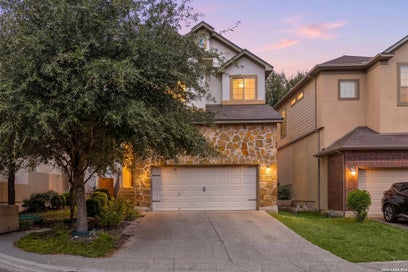
Stone Oak is primarily a resale market, which means the listings below represent real homes with real histories rather than builder spec sheets. Use them to understand what different price points actually deliver in this area — the difference between a $400K and a $600K home in Stone Oak is meaningful in terms of finishes, square footage, and neighborhood placement, and seeing active inventory is the fastest way to calibrate those expectations. Homes that are well-priced in Stone Oak move reliably, so if you’re serious about this area it’s worth being familiar with the market before you need to act rather than getting up to speed under pressure.




Still comparing north SA options?
These guides can help you think through the full picture:
Also comparing nearby areas?
Stone Oak is a consistent recommendation for families relocating from Dallas, California, and New York who want established north SA suburban living at San Antonio prices.
For the full north SA picture before you narrow to Stone Oak specifically, Where to Live in San Antonio maps how Stone Oak fits within the broader city geography and which buyer profiles each north SA community tends to suit.
Ready to Take a Closer Look at Stone Oak?
Stone Oak is a strong community with tons of perks, but it’s not the right fit for every buyer that researches it. Sorting through which neighborhoods, which school campuses, and which price points work for your situation is worth doing before you start making offers.
I’ve helped families find their fit in Stone Oak and across the north SA corridor. I grew up just outside San Antonio in Seguin and have lived here for 20+ years.
Schedule a Free Relocation Call
📞 210.236.2393 · ✉️ tammy@livinginsatx.com
Explore more: San Antonio Suburbs · Alamo Heights, TX · Shavano Park · Best Neighborhoods for Families · San Antonio Schools · Where to Live in San Antonio
Tammy Dominguez | San Antonio Realtor® & Relocation Specialist | License #684278 | Realty United, LLC